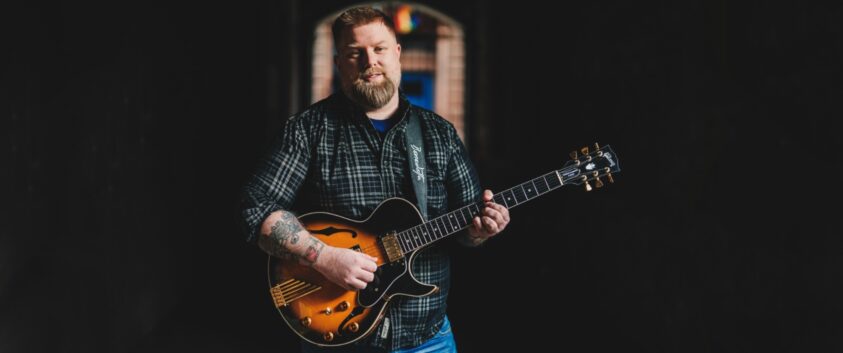
We’re delighted to be speaking with Levi Clay, a professional guitarist and respected educator, he’s also been a longtime Guitar Pro user. In this interview, he opens the door to his world, sharing his journey, influences, and insights to help you improve and take your playing to the next level.

Follow Levi Clay on social media!

Don’t miss out, subscribe to our newsletter to stay up to date!

How did you discover the guitar, and what made you start playing?

“I was around music when I was a kid. My grandfather was a semi professional guitarist in his youth and my grandmother met him when she was put in a duo with him as she played the piano. By the time I came along they’d both long since stopped playing, but his old acoustic guitar was always around and he kept his love for Django.

Sadly I didn’t take much interest in music until I was about 13. It’s a massive shift from where I am now, but I was really into Blink 182 and The Offspring. The thing that got me real serious was my girlfriend’s Dad (who also played) gave me an issue of Total Guitar magazine where Noodles from The Offspring, Joe Satriani and Mick Thomson interviewed each other. That was the moment I went from playing to be cool to playing because I had to.”

I know you also play piano, which instrument did you start with, and do you have a preference between the two?

“Oh, guitar all the way! As I just mentioned, I started playing guitar at 13, and I didn’t take up the piano until I was 32. Obviously I’ll always be a guitar player at my core, it’s all I’ve known for most of my life. Having said that, I gig more on the piano now and most of my practice time is devoted to the piano because it’s just given me a deeper access to music and ear training.”

Did you take music lessons, or are you self-taught?

“I’ve never liked the “self-taught” badge. I grew up really poor, so I didn’t have a teacher in the traditional sense. I would be given old magazines (we didn’t have the internet!) and I would learn everything in them. Then when I started earning money from a paper round, I subscribed to Guitar Techniques magazine. I was self guided, sure, but I would never call myself self-taught.

Every columnist I read was my teacher. Shaun Baxter, Guthrie Govan, John Wheatcroft, Jamie Humphries etc. I experienced my first 1:1 lessons when I went to college (Colchester) where as part of the music program you got a teacher… but the only teacher they had was a classical teacher, Adrian Johnson. So during that time I did classical guitar. I enjoyed it, but I was a rock guy who couldn’t give it the discipline it deserved to go all the way.


From there I went to London to the Guitar Institute where I had a lot of 1:1 time, both with guys at the school who taught my course, and privately with the great Martin Goulding. But again, to not pay tribute to the great guys who influenced me during that time like Max Milligan and Iain Scott would be dishonest.

On the piano/organ I’ve taken lessons with some amazing guys like Tony Monaco (B3 legend!) and Noah Kellman (amazing LA jazz dude!)

And that’s before mentioning the HUGE library of books I have from countless incredible authors who have all helped shape me. Mick Goodrick. William Leavitt. Randy Vincent. I could talk about teachers all day!”

Play Leaving London by Levi Clay!

What are your main influences?

“Those that know me know I play a lot of styles of music. You might know me as a rock/metal guy, a blues guy, a country guy, a jazz guy, or maybe you’ve seen my soul band in Glasgow. I play so many styles of music, not because I have to, but because there’s a genuine love and passion for so many styles of music. I will say this though, I mentioned why I started but I think (like many guitarists) I lost sight of that in the pursuit of knowledge and technique. In the last 5 or so years I fell back in love with songs.

Now I listen to a lot of great music and I can’t even tell you who plays guitar in the bands because it just doesn’t matter to me. So, dude in Lake Street Dive (I know I could have Googled but it would undermine the point!) hats off to you, I’ve listened to you play several times a week for a long time. You guys are awesome.

Oh… and musical theatre. Big musical theatre guy.”

You’re deeply involved in guitar education, having written 21 books, and taught millions of guitarists via Youtube, what do you enjoy most about teaching music?

“Anyone who has taken lessons with me, or follows my teaching will know that despite it being cliche, old sayings are often true. It’s amazing to get messages from people, or sit down with someone and help them get to the next level in their playing. Help them overcome the things they’ve not been able to with someone else. I’ve been so lucky in my life/career in that I didn’t start with much, but I came across so many people who were so generous and helped pull me out of what could have been a very dark life.

It wasn’t money that gave me a career, it was education. If I can help people become better and have better lives, is there any better feeling? It keeps me going! Over the last decade, my work had reached millions of guitarists through books, Youtube, and structured online teaching, but the real magic is getting to put faces to some of those success stories. Getting to know you guys!”

Where do you see the biggest gap between beginner/intermediate players and advanced musicians?

“Oh that’s easy! So on my site (GuidedPracticeRoutines) I work with hundreds of players and there’s this very obvious divide in players and it’s about helping them overcome that. Beginner/intermediate players don’t learn to play the guitar, they’re remembering how to play the guitar. It’s not really an understanding, it’s a memorization task.

Can they remember all the tab and move their hands in the right places to play it? Many people never overcome that, and that’s fine. But for me, the thing that pushes you into that next level is when you’re learning music and how it works. I can teach you an idea like closed voiced triads, we can practice them together, we can apply it to an etude etc… but if you panic when I say “ok, now you pick a song and apply the concept to it” then you’ve not really learned the concept yet, you’ve just remembered the exercise.”

Play Too Little Too Late by Levi Clay!

How long have you been using Guitar Pro, and which version did you start with?

“I got Guitar Pro 5.2 when I was in college. In school we were doing a lot of Bach chorals, counterpoint, and film scores… so it was Sibelius, but the guitar isn’t an orchestral instrument, there’s so much more we do in terms of techniques that I don’t find engraving software caters to guitar in the way Guitar Pro does. And it’s just got better and better as each version has been released.”

You’re widely regarded as one of the leading voices in guitar transcription. How do you approach transcribing a piece? What separates a “good” transcription from a truly great one?

“My background in classical and formal education might have given it away, butI’m a reader. While I create tab online for people, that’s about accessibility (because music isn’t to be gate-kept by those who can read), but when I’m actually creating work, it’s a simple process. Listen.Sing. Write. We can all do the first one. Some of us need work on the second. But the third one is where people struggle. Because I can read, there’s no trial and error when writing out what I heard.

I hear it, I can see it (because reading is seeing it and hearing it right?), andthat’s the separator between a good and great transcription. It’s important to remember that transcriptions are a learning tool, and they should make learning as easy as possible. Notation has conventions. So things like key signature, multi-voice writing, enharmonic, and correct use of ties to make reading easy all matter to me. You can learn to transcribe without knowing all that, sure… but when someone who understands the conventions sees it, i loks lyke ur riting Likethis, ifyo u C wat i meen?””

What’s your favorite feature in Guitar Pro?

“Oh the audio import feature for SURE. I don’t use it as a way to listen to the file. I load the audio in when the job is done. But being able to sync the file to the audio and deal with things like tempo accelerating, or free-time pieces is a complete game changer. I don’t know how I would be able to make some of the Youtube videos I make without it!”

Play Good Time Girl by Levi Clay!

Can you share five tips for editing scores like a pro in Guitar Pro?

“Just five??? Man, I’ve taught this software to SO many people I could give you 20! But ok, let’s try five!

  • So first up, get in Stylesheet and read EVERY little option, know what they are, work out what you want and create a default template. Are you going to be using dynamics? If you’re turning off notation, disable “Display circle around half and whole notes in tablature“, disable “Indicate where the string is touched for artificial harmonics in tablature“, disable “Hide useless rests on standard notation” etc. Let the program do some of the work for you with stylesheet presets!
  • Learn about beaming to make your transcription easier to read for readers, and look like the real deal. (It’s the Editing palette
  • Sextuplets are ok, stop having bars and bars of 16th note triplets!!!
  • Design mode is your friend. Organize your measure per line so the music isn’t too cramped (again, we want it easy to read!) but make sure new section start on new lines if you can.
  • You want to use as little ink as possible. Give the person as much as they need, and no more. If you’re using notation, put a key signature in, it will eliminate tons of accidentals in the score which will help space things much better.
  • And a bonus one… learn to notate bends so they’re both clean, but accurate to the intention!”

Time to play!

We hope you found this interview with Levi Clay both insightful and inspiring. Don’t hesitate to post your questions in the comments and let us know your first impressions!
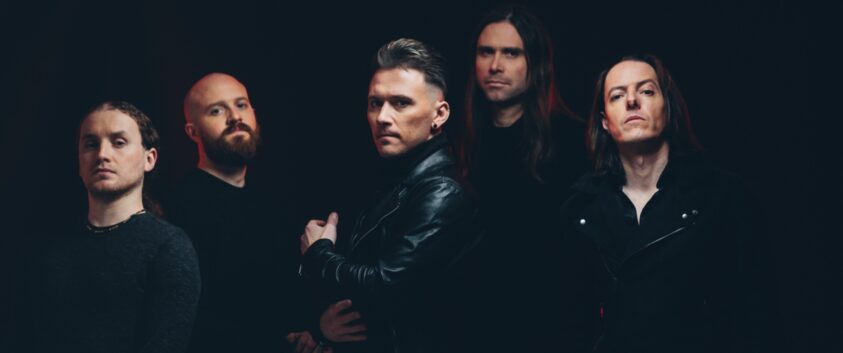
The progressive metal band TesseracT is back! Following the release of their 2023 album War Of Being, the British group is revisiting it in a fully instrumental version, yes, you read that right. For context, the album tells the story of two characters, Ex and El, whose ship crashes on the planet The Strangeland.

For this special release, War Of Being will be fully available in mySongBook, so the first five titles are available now, complete with vocals. Perfect for all Daniel Tompkins fans. Immerse yourself in the world of the album with these five extracts for guitar, bass, and drums, and enjoy the included Guitar Pro files. Download the demo and join Ex and El aboard their ship, heading straight to The Strangeland.

Explore the thousands of scores available on mySongBook, the official Guitar Pro catalog.
Play iconic tracks from some of the biggest metal bands, including Metallica, System of a Down, Slayer, Iron Maiden, Korn, Gojira, and many more.

Natural Disaster

This first snare roll is played as ghost notes, with the China cymbal following the guitar’s theme, which itself is played palm-muted. After the setup in measure 9, the bass comes in to play the theme in unison with the other guitars.
Pay close attention to the accuracy of the bends, and be careful when the three measures in 5/45/44/4 arrive, as they lead into the first verse.

Note: The track is played on a 7-string guitar, tuned A–E–A–D–E–A–D. The bass is tuned A–E–A–D and played with a pick.

Play the full track Natural Disaster in mySongBook.

Echoes

For Echoes, I’ve chosen to highlight the second verse, which I find particularly interesting. One of the guitars plays a funky pattern, which I think is very original in the context of the track. This is all accompanied by the drums, with the hi-hat played on every beat while the snare juggles various offbeat patterns. The bass is played with palm-muted eighth notes.
Watch out for the 6/4 measure that leads into the chorus.

Note: As with Natural Disaster, the guitars are tuned A–E–A–D–E–A–D. The bass is tuned A–E–A–D and played with a pick.

Play the full track Echoes in mySongBook.

The Grey

In the first verse of The Grey, you’ll encounter a rather complex pattern that you’ll need to practice slowly to master and play cleanly. The guitar and bass play this pattern in unison, starting on the first offbeat, creating a constant sense of syncopation. This section is played using left-hand tapping and pull-offs. Technical and rhythmic precision are essential to execute this part accurately.

Isolate the tracks in Guitar Pro to practice the more complex parts with greater precision.

The drums accentuate the guitar and bass on the kick and snare. The break in measures 36 and 37 will likely give you a real challenge.

Note: The track is played on a 7-string guitar, tuned Bb-F-Bb-Eb-F-Bb-Eb. The bass is tuned Bb-F-Bb-Eb and played with a pick.

Play the full track The Grey in mySongBook.

Legion

The bass part in the first verse of Legion is quite rhythmically complex. Even though it may seem simple since the groove is played only on Ab, I strongly recommend paying close attention to the subtleties in the choice of eighth notes. As you might expect, the drums accompany the bass with the kick, while the guitar plays an ambient, soaring pattern in the upper register.

Note : The track is played on a 7-string guitar, tuned Ab-E-A-D-E-A-D. The bass is tuned Ab-E-A-D and played with a pick.

Play the full track Legion in mySongBook.

War Of Being

Special mention for drummers: get your double bass pedal ready, you’re likely going to need it. The hi-hat plays on every beat, except during the eighth-note triplet patterns, which are played on the bass drum and accented with a crash on each beat. The guitars and bass support this heavy rhythm with surgical precision on the eighth-note triplets.

Note: As with Legion, the guitars are tuned Ab–E–A–D–E–A–D. The bass is tuned Ab–E–A–D and played with a pick.

Play the full track War Of Being in mySongBook.

It’s your turn to take on the challenge!

Think you can take on these five TesseracT tracks? Then it’s your turn to play!

End of transmission.

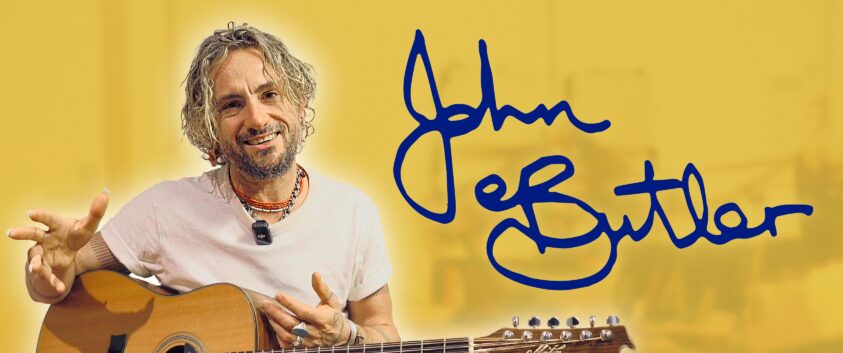
John Butler acoustic guitar lesson with tab

Hey guys, I had the chance to meet and interview John Butler backstage! The experience was incredible as John is one of my favourite artists and guitarists.

In this video, you’ll learn how to play “So Sorry” with John himself, one of his new songs released in 2025 from his album called PRISM. John walks us through the essential techniques behind the track and explains the tuning and right-hand approach that give the song its character.

The song is played in an open B tuning, which gives the guitar a rich and resonant sound.

The tuning is:

B – F# – B – F# – B – D#

This open chord tuning allows John Butler to create powerful octave textures across the fretboard. Open tunings are a big part of Butler’s style and help create the amazing sound heard in many of his songs.

Have fun!

Follow John Butler

Special thanks to John Butler and his team, Ludo Egraz from GuitareXtreme, Charlotte Delangle for helping me shoot the interview, Thomas Grundrich for editing the video and Christophe Maerten for editing the Guitar Pro tablature.

Tell us what your favourite John Butler song is in the comments.

Julien Bitoun, Guitar Pro, Thomas Duflos

Hi everyone!

I’m thrilled to share my interview with the illustrious and one-and-only Julien Bitoun.

Get an exclusive first look at the Guitar Pro Player, our upcoming mobile app.

What about you? Tell us your story with Guitar Pro in the comments. We want to hear it all!

The interview is in French, so don’t forget to turn on the subtitles.
Thomas

https://youtu.be/_VoC7rzj0C8?si=TjCQWFAaeCjrZFjU

Follow Julien!

If you haven’t tried Guitar Pro 8 yet, here’s your chance:

We’d like to thank FeedSpot for ranking the Guitar Pro Blog among the world’s Top 20 guitar blogs.

Guitar_Pro_Blog-FeedSpot

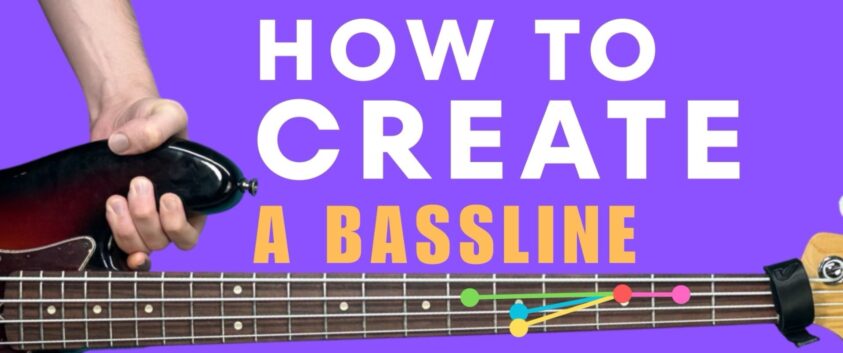
You’ve probably been waiting for this for a long time: an article dedicated to creating basslines. My friend Marcelo Maccagnan suggested developing a 5-level method to help you create and enhance your bass lines.
But first, let me introduce Marcelo in a few words for those of you who may not know him yet:

Marcelo Maccagnan is a Brazilian-born bassist, composer, and content creator based in New York City. Originally from Santos, Brazil, Marcelo pursued formal studies at the renowned Berklee College of Music, where he focused on jazz, fusion, and music production. After graduating, he relocated to New York, where he has continued to expand his artistry and professional presence as both a performer and educator.

As a versatile performer and session musician, Marcelo has collaborated with a wide range of artists across genres, including RINI, Simona Smirnova, Tigran Hamasyan, Kenny Werner, and Peter Eldridge. He has also appeared on Broadway as a substitute bassist for Wicked and Beetlejuice, a role that reflects both his musical versatility and technical command. In addition to his work as a sideman, Marcelo leads his own projects, with releases such as Looking Ahead, Boundless, and Night Tales, blending jazz, progressive rock, Brazilian music, and improvisational creativity into a distinctive voice.


Now that the introductions are out of the way, I’ll hand things over to Marcelo, who will walk you through the fundamentals of creating your own basslines. His explanations will be complemented by a few additional notes from me along the way.

Don’t forget to download the free Guitar Pro files, as well as the Guitar Pro demo, to get the most out of it.

Let’s get started

The role of the bass is both simple and powerful. As bass players, we are responsible for shaping harmony, defining groove, and supporting the entire band from the ground up.

This course provides a clear and practical framework for building strong, musical basslines. Through five progressive levels, you will move from playing simple root notes to incorporating octaves, fifths, chromatic approaches, and chord tones. Each level builds upon the previous one, helping you understand concepts that are universal to bass playing across most genres.

Whether you are a beginner developing your foundation or an experienced player refining your approach, these concepts will help you think beyond frets and start thinking about notes!

1 – Just Root 

Sometimes the root is all a song needs. At the end of the day, the bass is mostly a support instrument. Our goal is to provide the foundation from which harmony can grow.

This might seem simple, but keep this in mind: If the guitarist plays the chord Cmaj7 and the bassist plays the note C, the chord is Cmaj7. But if the bassist plays the note A instead, the chord is now Am7(9). That’s how important the lowest note (bass) is. It dictates the harmony of the whole song

This is also a great chance for beginners to focus on notes and not just frets. By thinking about which note you are playing and what the song’s actual chord is, you will open your mind to what music can be and stop being limited by frets

This should be what any bassist aims for. Knowing the notes (as well as the frets) is essential.

2 – Root/Octave + Groove 

This is an extension of level 1. But now we have the freedom to add rhythm to it. The best way to get started is to first learn all the roots you will need for the song, and then pay very close attention to the drums. Bass and drums are the foundation of the rhythm section. They bring the groove, rhythm, tempo and time into a song.

For bassists, locking in with the kick drum can be a very good place to start. Go listen to your favorite recordings and pay attention to what the bass and kick drum are doing. Often, they are locked together. However, oftentimes they are not! It’s okay to create variation and have a different groove on the bass. We can create counterpoint lines with the melody or guitar/keys. It is all about being creative.

At the end of the day, you need to be IN TIME. That is the priority

3 – 5ths 

Now we are getting into the bread and butter of bass playing. Adding the 5ths to your lines allows for some melodic variation and is a great note to play over a chord, since it has a very neutral tone and usually won’t clash with the other harmonic or melodic instruments.

Many basslines out there consist of just root and 5ths. And the good news is that 5ths are very easy to find on the neck. So make sure to add this to your basslines.

For beginners, try to find the roots of each chord first and then figure out a shape that allows you to play a root followed by the 5th without having to shift your hand. 

Note: be careful with chords that include a diminished fifth. The diminished fifth is a half-step lower than a perfect fifth. If you make a mistake, the half-step clash will be immediately noticeable. The diminished fifth is usually found on the VII degree in a major key, and on the II degree in a natural minor key.

4 – Chromatic Approach 

 We are moving now to what I believe is the 2nd secret weapon of bassists (the 5ths being the 1st). This is called chromatic approaches.

What does it mean? Anytime you hear the word chromatic you should think “half-step”. This is the smallest interval we can play on a fretted guitar or bass.

So a chromatic approach is when we have a target note, and instead of playing that note immediately, we “approach”/”prepare” it by playing another note that is either a half-step below or above it.

For example, my song has a C chord in the first measure and an F chord in the second measure. Instead of just playing C and F, I can play C > E > F. The goal is to play the F on the downbeat of the 2nd measure. But right before I do that, I will play the E which is a half-step away from the F. This gives the line more momentum to connect with the F.

We see a lot of upright bass walking lines in jazz. And it’s something we can add to any genre!

5 – Chord Tones 

Lastly, we have chord tones. These are very useful not only to create basslines but also to help you create fills and even solos. Chord tones are what make a chord that chord! You do need a little bit of theory to know this, but mainly, we just need to understand what makes a major or a minor chord

  • A major chord has a root – major 3rd – perfect 5th 
  • A minor chord has a root – minor 3rd – perfect 5th. 

There are many other kinds of chords, but for now, let’s just focus on these.

Reminder: the VII degree (in a major key) and the II degree (in a natural minor key) are exceptions, with the fifth lowered by a half-step.

If you understand these, you have now unlocked the 3rd of each chord. You can use it in your basslines, and it is the coolest part. In your bassline, you can use approach notes to target the 3rds and 5ths as well. This gives us almost limitless possibilities for basslines!

Now it’s your turn to play!

The concepts covered in these five levels form the foundation of strong, reliable, and creative bass playing. There is always more to learn, but mastering these will take you a very long way. 

From understanding the power of the root to incorporating fifths, chromatic approaches, and chord tones, you now have practical tools to construct basslines that are both supportive and expressive.

Remember: great bass playing is not about complexity, it is about clarity, time, and intention. Prioritize a solid groove, understand your harmonic role, and make deliberate note choices.

Master these fundamentals, apply them to real songs, and continue listening deeply to how the bass interacts with the band.

The stronger your foundation, the greater your freedom!

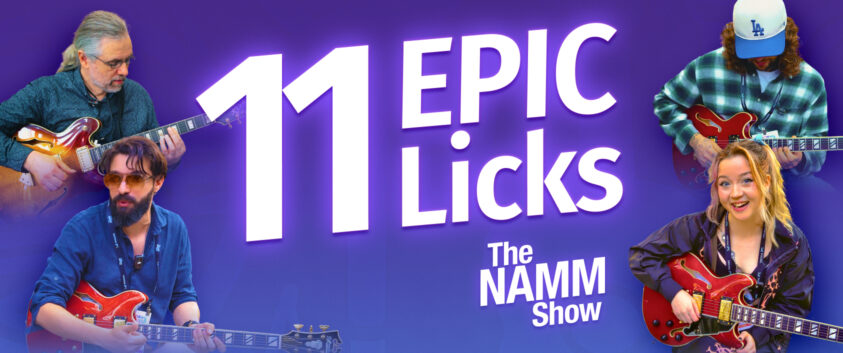
We had the honor of meeting 11 internationally renowned guitarists who, in addition to being highly influential on social media, are loyal Guitar Pro users.

I invite you to play 11 licks crafted by these masters of the instrument, including free downloadable Guitar Pro files. You’ll find all 11 licks in the NAMM Show 2026 recap video below:

Roman Bulakhov

Roman is a guitarist and producer based in Los Angeles, specializing in jazz fusion, neo-soul, and rock. He is also the guitarist for the Ukrainian band Nervy, with whom he regularly tours.

Here, he shares his signature vocabulary over a D-9 chord, blending broken scale patterns, chromaticism, bluesy phrasing with the addition of the blue note, enhanced with slides and pull-offs.

Jens Larsen 

He needs no introduction: Jens Larsen is a pioneer of jazz guitar on YouTube. With over 1,600 videos to his name, the II–V–I holds no secrets for him!

That’s exactly what he’s sharing with us here: a beautiful II–V–I in G, featuring an A-9, an altered D7, and a Gmaj9, enriched with chromatic descents and beautiful harmonics.

J9

Pedro Joaninho, aka J9, offers his services as a live and studio guitarist, musical director, and educator. He is also the guitarist for the hard rock band The Redbeds.

Here, J9 plays a purely blues-rock phrase, starting with a bend and incorporating the blue note into the minor pentatonic scale.

Lior Krief

Lior Krief, a French gypsy jazz guitarist heavily influenced by Django Reinhardt and George Benson, is also the son of the renowned guitarist Serge Krief.

With several albums already under his belt, Lior phrases over a II–V–I in G, using chord arpeggios enriched with chromaticism and slides. Be warned, it’s very fast!

Gabeflow

Besides being an exceptional skateboarder, Gabeflow is above all a highly skilled musician. He is a guitarist, influencer, educator, and a longtime Guitar Pro user.

Gab shares his neo-soul style with us, playing legato phrases and adding chords along with subtle touches that link tension and resolution.

Roy Ziv

Guitarist Roy Ziv first gained recognition on social media with his humorous videos, often portraying teacher/student or producer/musician scenarios. He is also an expert in the art of adding and rearranging solos on well-known songs.

Roy presents a fantastic bluesy lick, featuring, as always, the blue note that brings the minor pentatonic scale to life. The addition of bends and hammer-ons/pull-offs gives the phrasing its full expression.

Jason Recht

Guitarist, composer, and producer Jason Recht is a talented musician with a growing reputation. He enjoys playing his own compositions and sharing videos on social media, alternating between guitar, bass, and sometimes even drums.

Here’s a right-hand alternate picking lick, based on a descending major pentatonic scale. The pull-offs allow the right hand to maintain the same picking direction throughout.

Pritesh Walia

Pritesh Walia is an accomplished jazz guitarist, educator, and former student of the renowned Berklee College of Music. In 2023, he released his first album, titled Hope Town.

Pritesh plays an altered lick over a B/C chord, clearly reflecting the influence of Scott Henderson.

Eric Matern

Our friend Eric Matern kindly joined us to talk about Guitar Pro. Eric works closely with the Cort brand and released his first EPSide Quests and Crooked Steps, in 2025.

Mostly rooted in rock and metal, Eric presents here an atmospheric pattern, driven by a palm-muted bass and hammer-ons, which reveals its full richness through the chord changes.

COBURN

Erin Coburn, known as COBURN, is a guitarist capable of blending metal with pop, a rare combination that works remarkably well and brings a fresh perspective to the metal we’re used to hearing.

Like her counterpart Eric Matern, Erin surprises with a riff outside her usual repertoire: a catchy rock riff, enhanced with pull-offs that give it an almost country feel.

Nick Hames

A blues-rock specialist, sometimes reminiscent of John Mayer, Nick Hames released his first EPThe THEN and the NOW, in 2024 under the artist name HAMES.

His influences are clearly felt in this blues-rock lick, featuring bends, the blue note, and the pentatonic scale.

But that’s not all…

Since you’ve made it this far, I’d like to share 2 bonus licks from our friends Raoul Tchoï and Kupre.

Raoul Tchoï

Raoul-Tchoï

Playing guitar, bass, and even keyboards at such a high level isn’t easy, but that’s exactly what Raoul Tchoï does. He has even become a content creator for the industry giant Thomann.

Here’s a diatonic descent, starting on the open B string and resolving down to D6.

Kupre

Kupre

Agustin Kuprewicz, known by his artist name Kupre, is an Argentine guitarist we met at NAMM 2026. He creates videos and tutorials for both acoustic and electric guitar on his YouTube channel.

In this example, Kupre plays the arpeggios of the I, IV, VII, and III degrees in C major, before resolving to the I chord.

Which one was your favorite?

Let us know in the comments which lick is your favorite! Enjoy these valuable licks, I’m sure they’ll help you make great progress.

Blog cover bass templates

Discover our collection of free blank bass sheets to download. Whether you play a 4, 5, or 6-string bass, you’ll find the perfect template to write down your bass lines, compositions, and musical ideas. These templates are fully compatible with Guitar Pro for easy, professional editing.

Many bassists look for blank sheet music adapted to their instrument, but it’s often difficult to find the right format. With Guitar Pro, you can customize these templates in just a few clicks to fit your specific needs: custom tuning, number of bars, treble or bass clef, tablature only, or combined with standard notation.

If you prefer developing your bass lines directly on the computer rather than on paper, Guitar Pro provides all the tools you need: sheet music editor, bass amp simulation, dedicated effects, and realistic audio playback.

Try Guitar Pro free for 7 days

Feel free to share your suggestions and questions in the comments.

Blank bass sheets to download and print

4-string bass

Blank sheet music for 4-string bass

Blank sheet music for 4-string bass

Template in bass clef with standard staff for 4-string electric bass (tuning E-A-D-G).

Blank tablature for 4-string bass

Blank tablature for 4-string bass

Tab-only template with 4 lines to easily write down your fretboard positions.

Standard notation + tabs for 4-string bass

Standard notation + tabs for 4-string bass

Complete format combining bass clef staff and tablature for precise and accessible notation.

5-string bass

Blank sheet music for 5-string bass

Blank sheet music for 5-string bass

Template specially designed for 5-string bass with an added low string (tuning B-E-A-D-G).

Blank tablature for 5-string bass

Blank tablature for 5-string bass

Tab-only template with 5 lines to easily write down your fretboard positions.

Standard notation + tabs for 5-string bass

Standard notation + tabs for 5-string bass

Complete format for 5-string bass combining standard notation and tablature.

6-string bass

Blank sheet music for 6-string bass

Blank sheet music for 6-string bass

Template specially designed for 6-string bass with extended range (tuning B-E-A-D-G-C).

Blank tablature for 6-string bass

Blank tablature for 6-string bass

Tab-only template to explore the full potential of the 6-string bass.

Standard notation + tabs for 6-string bass

Standard notation + tabs for 6-string bass

Template for 6-string bass with maximum range (tuning B-E-A-D-G-C).

With Guitar Pro, you can easily create your bass sheet music: transpose in 1 click, adjust the layout to your preferences, use bass-specific scale diagrams, and add audio tracks to build complete playbacks.

With tools like the metronome, looper, bass fretboard view, and bass amp simulators, you’ll be able to improve your technique and develop your groove faster.

Sharing your music has never been easier. With Guitar Pro, export your bass compositions in multiple formats (PDF, MIDI, WAV, MP3) or print them for rehearsals and gigs.Share your feedback and questions with us in the comments.